Agent browser & systems integration
BrowserAI DUO
BrowserAI DUO is my independent fork of BrowserOS Neo for Claude, Codex, and other MCP clients. I extend an existing Chromium-based agent browser with scoped evidence queries and bounded action plans, while keeping a separate app, profile, MCP connection, and saved skills. The existing macOS alpha was published as BrowserRAD; the new BrowserAI DUO build is pending. The fork builds on BrowserOS and Chromium.
Explore the source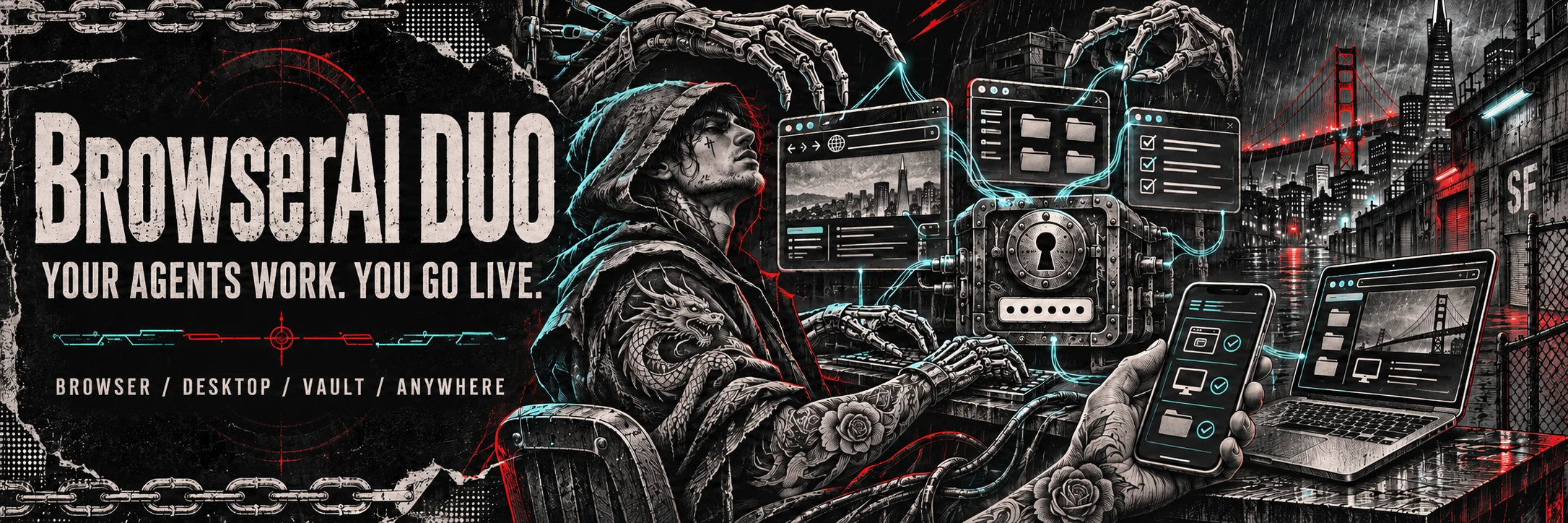
By Angelo De Leon · Updated
Useful browser evidence without unnecessary turns
A browser agent can spend much of its work waiting for pointer animation, repeating observations, or returning page detail the planner does not need. BrowserAI DUO explores improvements close to the browser runtime: scoped reads, several literal queries over one fresh capture, and compact results.
The goal is less avoidable overhead while retaining checks around actions and outcomes. It is a development goal, not a general speed, token-savings, or cost-reduction guarantee.
Shared evidence and bounded action plans
The fork adds runtime helpers that compose the existing guarded browser SDK. Shared evidence queries return bounded excerpts with explicit counts and truncation. Bounded plans resolve fresh, unique targets, check the expected origin, and verify postconditions.
Ambiguous targets, incomplete evidence, and unexpected origins stop the plan. If an error follows input, the result can be uncertain: the action may already have happened. Recovery needs a readback before retrying. The deterministic plan path does not require a second model or an automatic vision pass.
A fork that coexists with its upstream browser
BrowserAI DUO remains separate from upstream Neo. Its rebrand retains the BrowserRAD fork’s profile, bundle ID, state and Keychain identity for continuity, while the visible app name and canonical MCP name become BrowserAI DUO. It is designed to run alongside BrowserOS Neo without migrating its profile or silently substituting one browser for the other.
The implementation retains upstream-compatible package names and build selectors where possible. The work spans the Chromium build and Python packaging layer, Rust MCP runtime, and TypeScript agent interface. BrowserOS and Chromium supply the underlying browser; this portfolio entry describes my fork-specific integration work.
Alpha packaging and measurement limits
The previous Apple Silicon macOS alpha was released as BrowserRAD. The BrowserAI DUO name and artwork are in source; a renamed native build is not yet published. The earlier alpha used ad-hoc signing without Developer ID signing or notarization. Linux and Windows installation coexistence is not established by the macOS work.
The branch distinguishes source implementation, isolated smoke checks, and installed-build acceptance. Published fixture and prototype measurements are narrow experiments, not a general end-to-end agent benchmark. This site update does not claim a completed BrowserAI DUO native build, matched agent benchmark, or validated browser-to-desktop workflow.
Project questions
Is BrowserAI DUO an original browser engine?
No. BrowserAI DUO is an independent fork of BrowserOS Neo, built on Chromium. The upstream browser and notices remain attributed; my work focuses on the fork’s execution helpers, integration boundaries, identity, and packaging.
How does BrowserAI DUO relate to BrowserHelm?
BrowserAI DUO is the browser and its agent-facing runtime. BrowserHelm is a separate gateway between assistants and browser agents, focused on context handling and routing. They are distinct projects at different integration layers.
Related writing and services
- BrowserAI DUO implementation and build guide
- Measurement protocol and limitations
- Upstream BrowserOS project
- BrowserHelm: the separate agent gateway
- AI implementation and integration work
I’m based in San Francisco and work with teams remotely. Tell me about your project, or review my engineering experience.
This case study describes the project and its tradeoffs as reviewed onNovember 16, 2026. The public repository is the source for current implementation details, requirements, and validation notes. The image above comes from the project’s GitHub repository.